Thursday, February 9, 2012

A Trip to the Hospital

As the ladies arrived back home from our lumu outing, Wade was ready to head over to the hospital.  He, Lalas and Eric had been working construction under the brutal sun all morning, and after a drink of water they piled in the truck along with Tonya and me.  It was so hot I wondered what manner of grace enabled the two white men to labor so hard without being overcome by the sun.  At noon the thermometer was already close to 120 degrees, and after lunch and a short rest they would be back at it with their shovels and wheelbarrows. 

Entering Mansoa on lumu day was more chaotic and congested than even the usual bedlam in the streets of the busy town.  People everywhere with something to sell or looking for something to buy seemed almost oblivious to the motor vehicle pushing through the throng.  A man covered in sweat on top of a toka-toka was securing a squealing pig struggling to escape from the ropes, while her piglets were tied, each by a rear leg, to a tree in the shade below.  Vendors' displays had migrated so far into the road on each side that they had to be pulled back in order for the truck to have room to pass.  And somewhere beyond this cauldron of humanity was a hospital where the sick hoped to find healing after the ministrations of the local witchdoctor or their pleas to Allah had left them worse off than before. 

Every image I ever had of a hospital vanished from my mind the moment we pulled in and parked the truck in a patch of dirt outside a low sprawling complex of buildings that looked more like an ancient military barracks than a place where medical care might be dispensed to the sick and dying.  Chickens, pigs and goats wandered freely between the buildings, while women and children with baskets of food sat on the edges of the concrete walkways in front of open doors into small, dark rooms.  A woman with a huge plastic tub on the ground beside her threw a dozen identical large, dark green cloths over a clothesline, and a queue of people stood waiting to enter a room at one end of the first building.  It was so hot I was anxious to get out of the sun, and it occurred to me that the sick people in these buildings must be stifling in the heat of their tiny rooms without so much as an electric fan to cool them. 

After Wade got clearance from someone in authority to visit patients, he sent Lalas & Tonya in one direction, Paulu & Eric in another direction, and took me with him.  He explained that it wouldn't be a good idea to have such a big group of white visitors descending on people, and by breaking up we could cover more ground and pray for more patients. 

Wade and I walked past a lot of curious eyes on our way around to another barracks-style building, across the dirt yard and over to a particular destination he had in mind.  Passing by a series of closed doors, we came to an open door on an inside hallway where three concerned women sat on the edge of a bed with bundles of food, while an older woman sat on another bed next to a beautiful young woman who was obviously the patient.  My first thought upon seeing this lovely woman lying on the bed with her eyes closed was that she was waiting for her facial at our salon.  In the previous three days I had seen nearly twenty dark-skinned women lying just like this on a small bed with their eyes closed, enjoying the pampering we were lavishing on them.  But this was not the Jesus Spa, and this young lady was not waiting for a facial.  Her family members told Wade that she had been like this for two days, and they couldn't get her to wake up or eat or talk.  It was apparent from their explanation of her condition that they didn't understand that she was in a coma.  Wade asked their permission for us to pray for her, and we kneeled on the concrete beside her bed and laid our hands on her and prayed.  After a few minutes Wade spoke with the mother again, and then we prayed some more.  After repeating this a third time without seeing any change, Wade told the family he would come back and check on her later and pray for her again.

Then we made our way around to a different building looking for another open door with a patient who would welcome prayers for healing.  In spite of the conflict of religions, those who are sick with little hope of recovery generally welcome any compassionate offer to help them find relief.  Through this ministry Wade has had the opportunity to lead several Islamic or animist people to faith in Jesus Christ after they or a family member or friend had been instantly healed.  And for those who have been healed but didn't choose to put their trust in Christ at that time, they have the physical testimony in their bodies that will forever remind them of where their restored health came from, and perhaps they will eventually respond to the wooing of the Holy Spirit to draw them in.  Deafness being replaced by hearing, large tumors disappearing within minutes, pain leaving a body as prayers are going up to heaven, muscles and bones mending and being useful again - these are undeniable manifestations of a loving Father's compassion for the suffering, and it gets the attention of many who might otherwise have no interest in hearing the Gospel message. 

The next room we entered, just like the first, was about twelve feet square with five beds lined up around the walls.  The only other furnishings in the room were two small tables.  Each metal bed with thin mattress had long sticks wrapped around the four corner posts, which I eventually figured out must have been to hold up mosquito nets during the rainy season.  On one of these beds sat an older woman holding her left hand in her right hand, looking worried.  Wade had a conversation with her in Creole and learned that her left hand was swollen and nearly useless, while her right shoulder and upper chest were in so much pain so that she couldn't move her right shoulder or arm.  She gave us permission to pray for her in the name of Jesus, so Wade placed his hand on her swollen left hand while I placed my hand on her right shoulder as we kneeled on the concrete and prayed.  When Wade asked her to try moving the fingers on her bad hand, there was an obvious increase in movement from before the prayer.  When he told her to try moving her right shoulder and arm she actually stretched her right arm clear behind her back, stretching and bending over and over, demonstrating that she had full range of movement in that shoulder with no pain!  He prayed for her hand again, and again she demonstrated an increase in strength and movement in that hand.  After the third time she was able to gently grip Wade's hand, whereas she had had no grip at all when we first met her less than ten minutes before.  Wade then shared the message of Jesus with this animist lady and invited her to put her trust in Him.  She didn't do that at the time, but seeds were planted as her body received a touch of healing and her heart heard a message of love and hope. 

Later in the day Wade made a trip back to the hospital to check on the young woman in the coma.  He found her sitting up in her bed eating dinner!  Glory to God!

Since Wade and his companions began their weekly hospital visits a couple years ago, the Mansoa hospital has risen in national ratings to the position of #1 in the country for patients experiencing healing of their illnesses, and for having the least number of infections develop while in the hospital.  Needless to say, the staff are always happy to see them come.  Jesus is making a name for Himself in this place.

Once again, through my hospital visit this time, I was confronted with some harsh realities that provided perspective to my ingrained sense of entitlement toward expected availability of goods and services in my own country.  At least in U.S. hospitals I can expect there will be linens on the bed, air conditioning in the summer, a high level of sanitation, meals delivered three times a day, and actual American Board Certified medical doctors running tests, making diagnoses, and prescribing appropriate treatment.  The hospital in Mansoa was more like a warehouse for the sick, making do the best they could with crude conditions and one doctor for every 20,000 residents.  God help these poor people.


Wednesday, February 8, 2012

The Lumu

Thursday around noon is Wade's usual time for visiting the hospital in Mansoa to pray for the sick, and I wasn't about to miss out on this opportunity to participate.  But before the appointed hour for that outing we had some shopping to do at the lumu.  Once a week a flea market comes to town, bringing all sorts of goods that have been purchased sight unseen in a giant bale or bin for resale piece by piece.  These loads of goods may come from the U.S. or Brazil or other countries that sell bulk lots of used clothing, excess wares from department stores, or other items no longer sellable in more developed economies.  Local people seen sporting jeans or other obvious western fashions have most likely found them at the lumu, and they are a hot commodity among the teens and young adults in the area.  Kate often finds decent clothing for herself or her family, or household items that are not available in the local markets.  So off we went into town for Thursday morning at the lumu, minus one important item in my bag. 

The single biggest disappointment of my visit to Guinea Bissau was the blinking message on my camera that the battery had consumed its last drop of power.  As this was a new camera, I didn't have the experience to have learned that I should have purchased a second battery to carry with me on a trip.  The charger for my camera battery was back home in the States, but it wouldn't have mattered if it had been in my possession since there would have been no place to plug it in anyway.  And so my stomach dropped to my feet when I realized I would have no means of taking pictures for the remaining days of my visit.  No pictures of the lumu.  No pictures of the hospital.  No pictures of the last two days of our Jesus Spa.  Oh, Lord, Lord, Lord, this was a bitter pill to swallow!  But I couldn't afford to allow myself the luxury of wallowing in this disappointment, as it would have severely detracted from the focus of our mission.  As much as I loved capturing every little experience with my camera lens, the truth was that I had not made this trip to Africa for a rare photo shoot opportunity.  I had come here to bring the love of Jesus to women who were born into an environment where evil has been in power over families for countless generations, holding them captive to lies and eternal damnation while robbing them even in this life of the most basic levels of respect and dignity and value that we take for granted.  How could I indulge such an insignificant disappointment in this context?  And so I gave that frustration over to the Lord.  And I gave it over again the next time it started squeezing my belly with anxiety.  And again when tears threatened to spill from the regret of inadequate planning.  And again, and again, and again.  My camera battery had coughed up its last bit of juice on Wednesday morning, but 24 hours later I was still having to give my disappointment back over to the Lord every few hours.  It was an embarrassing reminder to me of how coddled my life has been that this would even be an emotional challenge, as if it could possibly compare with the difficulties these Guinean women deal with every day of their lives.  How many children of mine have died from malaria?  How many times have I walked miles with tubs of heavy, wet laundry on my head so that I could spread it over some bushes to dry?  How many trees have I chopped up so that I could make the fires needed to cook dinner for my husband?  How many acres of rice have I planted with a baby strapped to my back?  How many times have I had an illness that needed a drug that is readily available in our country, but for lack of $1 I was unable to purchase it and had to simply suffer and hope that my body would be able to fight off the bacteria on its own?  No, I had no legitimate case for indulging my disappointment over lack of a camera. 

And so we scanned the goods at the lumu, scouting for items that might be of use to Kate or her husband in their home or at the YFC center.  She picked up a couple t-shirts for the boys, and another small item or two after skillfully negotiating prices with the shrewd sellers.  A white person in that setting might as well be wearing a neon sign wrapped around her body flashing, "Rich person here!  Exploit me as you wish!"  But Kate's practiced bartering skills, combined with her fluency in the language, serve her well in that setting. 

Tonya found a skirt that she liked, and with Kate's help she bought it for about $1.  We were all pretty happy for Tonya to have stumbled onto something that looked like it had been designed with her in mind, and she looked forward to wearing it soon.  With the limited apparel we brought with us, it was helpful to her to acquire another skirt.  When we met Maria back at the truck after our allotted shopping time was up, she was surprised to see that particular skirt in Tonya's possession.  She explained to Kate, who translated the story to us, that she had seen that very skirt and wanted to buy it.  The seller told her he would sell it to her for 350 CFAs, equivalent to about $.75, but she only had a 1,000 bill.  He told her she would have to go find her own change and then come back to buy the skirt since he had no cash with which to make change.  When she returned with the right change a few minutes later, the seller told her he had just sold the skirt to a white lady.  Ha!  He was going to sell it to Maria for $.75, but he held out for $1 from the white missionary!  We all had a good laugh over that story and the coincidence that of all the thousands of items for sale at the lumu that day, Maria and Tonya had their eyes on the very same piece of merchandise.   
Tonya with Eric, wearing the skirt loved equally by an American woman and a West African woman.
(Photo taken with Tonya's camera.)

Kids, Kids & More Kids

Our target ministry was to women, but where there are women there will be kids, and Guinea Bissau is no exception!  Enjoy all the sweet faces.

Kids under our own roof
Abigail & her precious Beauty, the world's
ugliest chicken (but loved all the more
because of his ugliness)

Caleb, dog trainer, rooster catcher, and
missionary in training
Josiah, American by birth,
Guinean by life experience

Not too sure which ones are the kids here

Kids belonging to Lalas & Maria and Paulu & Fatinia in the twin house


Kids getting a ride in the truck


Kids playing together during salon sessions


Kids in the Mansoa market


Kids in the tiny Monsanka villages


Kids searching for breakfast


Tuesday, February 7, 2012

Home Is Where the Heart Is


Wade & Kate McHargue's home is a place built with love and sustained by love.  Their marriage, their children, the house, the ministry, it's all an expression of their love for the Lord and for people.  Without that love they could not carry on the work they are doing in such trying conditions.  It puts me to shame when I think of all the times I've whined about the work involved in cleaning my house, after seeing what's involved in keeping up Kate's house with her water situation and limited access to tools and supplies.  Vacuum cleaner?  Nope.  Sponge mop?  Nope.  Dishwasher?  Nope.  Washing machine?  Nope.  Paper towels?  Forget it!  Trash pickup service?  Are you kidding?!?!?  Trash gets sorted into three categories - that which is edible and can be fed to the animals, that which can be burned, and that which has to be buried.  Floors throughout the house are washed every day because of the amount of dirt tracked in even with shoes being left at the door, and watching Rosa do the cleaning for a week made me cringe over the physical demands on Kate's body. 

Dishes are washed in a pot or a bowl with water that has been carried from the well, and most of the time it's not even worth the effort to heat the water for washing or rinsing dishes because of the exorbitant cost of propane to fuel the stove.  A generator provides electricity for the barest minimum of needs, which translates to about 3-4 hours of powering lightbulbs each evening so the family doesn't have to go to bed when the sky gets dark like the natives do.  Laundry is scrubbed on a washboard in a large tub out in the yard, then hung on a line for the sun to dry.  Since my luggage was stuffed with supplies for our Jesus Spa, I brought few clothing items and needed some of them washed midweek, so I paid Rosa's sister Naoza about $2 to perform this service for me. 

In a country where the nearest place to purchase toilet paper is 40 miles away, Kate's family has learned to conserve and minimize waste to a degree that we spoiled Americans rarely even consider.  Eating the main meal from a family bowl cuts dirty dishes and cleanup by about 75%.  Foregoing all plates for lunch and breakfast eliminates the need for water and soap to clean dishes, requiring only a few swipes of a rag to remove sticky smudges and crumbs from the table.  Wearing clothing items multiple times regardless of soil and sweat conserves water and energy that could easily be squandered on trying to maintain a rich man's standard of cleanliness.  And yet there is no slovenliness.  Even among the poorest of the poor, bodies are bathed daily and women's hair is their crown of loveliness.  Although Kate's children are properly dressed by our standards, young children of the local citizens are left naked or mostly naked much of the time because it is easier to wash a body than to wash clothing.  And local women do their bathing together at a well rather than carry their bath water all the way home every day in addition to the chore of hauling drinking and cooking water for their families' needs.  This may offend our sense of modesty, but it is a practical necessity for many who are overworked and under-rested.  Kate recognizes that she is blessed to have an indoor bathroom with a toilet that can be flushed with a splash of water from a bucket, and a sink and shower pan where bathing can be done indoors in privacy with drains that carry away the dirty water. 
Would you rather bathe here . . .

or here?
In spite of the presence of litter virtually everywhere the Guinean people are living, whether in tiny villages, bustling towns, or the capital city, inside the homes the dirt floors are kept swept clean with handmade palm brooms.  The people do almost all their actual living outside rather than indoors, which is primarily a place for sleeping, so it's not nearly as hard for them to keep their sparsely furnished houses clean as it is for Kate, whose family insists on doing much of their living indoors like other Americans! 
Notice the vultures in the tree.
Photo taken in Bissau, the capital of Guinea Bissau.

Bissau city street
Much of life for Americans in West Africa still happens indoors.
But while life in West Africa has many challenges, one of the treats that I particularly enjoyed was the night sky.  Without the presence of artificial lights obscuring the view, the natural lights in the heavens are magnificent in their brilliance and abundance.  I was taught in elementary school half a century ago that all those stars and planets are up there all the time, but only in a planetarium have I previously seen the awesome sight of a vast night sky lit with millions of dazzling specks in a full circle from horizon to horizon in every direction.  Truly the heavens proclaim the glory of God!

Listening Prayer

Bringing pampering to the women of Mansoa wasn't the only blessing being delivered in Guinea Bissau during our visit.  Katie had a blessing in mind for Tonya and me as well.  One morning the three of us gathered in the comfort of her living room with our Bibles and notebooks in hand, and she instructed us in the art of listening prayer.  We already knew how to speak to God, and we already knew how to recognize His voice when He spoke to us, and now we were going to learn to focus our listening specifically for the benefit of a chosen recipient.  After getting our instructions, for fifteen minutes Kate and I opened our spiritual ears to hear whatever God might have to say to Tonya for her edification and encouragement.  We scribbled notes, drew pictures, and located scripture references in our Bibles as the thoughts came like a stream.  I had entered into this activity with doubts about my ability to hear clearly.  In fact, before making the trip to Africa I had expressed to a few friends that this was the only part of our planned mission that left me feeling very insecure.  The original plan had been that we would have listening prayer over half a dozen local Christian women, but as it turned out there simply wasn't time to work this into the activities of the week.  Kate had experienced this herself in the context of a conference for Christian missionary women in West Africa, where about two hundred women blessed each other with listening prayer, one by one.  As this experience had ministered powerfully to her, she had the desire to pass on the blessing to others. 

When our listening time was up, Katie and I took turns sharing with Tonya what we had heard the Lord say concerning her.  Though I had entered into this with apprehension, once the thoughts started flowing I knew that the success of listening prayer depended not so much on my listening skills as on God's speaking skills, and He is not lacking in this ability by any measure!  He spoke clearly to Noah about building an ark to spare his family and a pair of each species of animal and bird from the coming flood.  He spoke clearly to Abraham to take his family and go to a land that would be shown to him when he got there.  He spoke clearly to Moses with instructions to return to Pharoah and lead the Hebrews out of Egypt.  Throughout all the recorded Old and New Testament times God spoke clearly to those who had chosen to follow Him, and sometimes to those that He chose to snatch out of their rebelliousness or misdirected religious passion.  When God speaks we can choose to listen or we can choose to tune Him out, but for those who have ears to hear there will be messages of wisdom, guidance, encouragement, exhortation and insight.  And so, with a desire to receive a message for Tonya, Kate and I had asked the Lord to open our spiritual ears to hear.  When I expressed one particular message I received that didn't make sense to me, Kate was able to supply the other half of it from her time of listening!  After I read the passage of scripture that I had been led to for Tonya, Kate declared that she had the very same scripture!  And it was clear from the emotional response that Tonya's heart was being touched at a deep level.

And then it was my turn to be the recipient of listening prayer.  Tonya was, if possible, even more apprehensive than I had been, but it was obvious from the page of notes she scribbled that God was able to make Himself heard even by one much younger in the faith.  My heart was moved deeply by the messages that Kate and Tonya delivered to me from God.

Though we didn't have the opportunity to do listening prayer over any of the African Christian women, we did bless another missionary with this gift.  Liz and her husband William live about an hour's drive away in the town of Lendeng, on assignment with SIL, a language translation organization.  The work she is doing to help small translation teams bring written language to several people groups in the country is simply amazing.  Not only does she guide and oversee their work in translating portions of scripture, but she and her teammates produce remakes of the Jesus film in each of these languages being studied and developed for evangelistic purposes.  Voice actors have to be located and taught to read in their native languages, then audio recordings are made of voice-overs for the film.  Recording of these tediously prepared scripts is done in tiny makeshift, airless booths where the actors emerge after an hour drenched in sweat like they'd taken a dip in the river.  Liz and her husband are an important strand in the network of selfless, dedicated workers bringing Christ to this dark corner of the world, so it was our joy and privilege to visit in their home and gift Liz with listening prayer. 

Nothing Worth Doing Is Ever Easy

Wade and Kate McHargue were informed by the Youth for Christ organization that their particular placement in Mansoa, Guinea Bissau, is one of the most difficult assignments YFC has in the entire world.  The turnover rate for missionaries in West Africa averages 3 years because it is such a difficult field for an American to work in.  Living conditions can be grueling, good healthcare is nearly nonexistent, frustrations can be discouraging to the point of giving up, and relationships with local residents and government officials can sometimes be severely strained.  But God has granted an amazing amount of favor to this young couple in the eyes of those who have the authority and the power to make life miserable for them or even force them out.  The Muslim mayor of Mansoa gave her blessing for them to do the work they came to do, with no hidden agenda.  In spite of Wade's candor with everyone about why they are there and what they hope to accomplish, with few exceptions they have been welcomed and encouraged.  His efforts to build relationships with men at the local military base were strained at first, but as he continued coming back on a weekly basis they have warmed to him and now even look forward to him coming and bringing them messages of news about their worth in the eyes of the one true God.  His visits to the hospital to pray for the sick were initially met with suspicion, but his genuine compassion for the suffering, and his faithfulness in returning every week, have brought about a respect that is hard to explain apart from God's favor in an animistic and Muslim culture.  The weekly radio program that airs every Friday evening is drawing more and more listeners across the country, and each week they get phone calls from people wanting more information, wanting to meet with one of the men to talk about Christianity, or thanking them for bringing the news of hope and salvation in Christ that is changing their lives.

In every society and culture there are obstacles to the gospel message.  In the United States one of the biggest obstacles is our affluence, as well as our tenacious grip on independence.  We have so much that we can easily be blind to our needs.  And we are convinced that we can do it ourselves if we just try hard enough and get enough breaks.  But in spite of how hard we work, how much we accomplish, how polished and together we look on the outside, it is only the power of Almighty God that can remove our guilt and free us from the power of sin in our lives.  In a culture like that of West Africa, where everyone except those in high official positions of power are deprived and impoverished by nearly any standard, there are fewer masks to hide behind and fewer ways to be deceived about one's need for a savior.  But there are still plenty of ways for people's lostness to express itself destructively, and one of the most common in this country is alcoholism thanks to the perversion of one of God's gifts to the people of this region.

The cashew tree is as common in Guinea Bissau as a scrub pine along the east coast of North America.  The people harvest the nuts for their own use, but due to corruption in the government there is little exporting which could potentially benefit the hungry people in this country with a sizeable profit that would help ease their constant struggle to find food.  And, as if that situation weren't bad enough, each cashew nut has a little fruit attached which contains a sweet juice that ferments naturally in the extreme heat of the climate.  So, the trees that could potentially bring an increased level of well-being to the populace, is instead being used primarily as a source of self-destruction among the men of this country.  Cashew wine is the drug of choice, and the clutches of addiction are deeply embedded in the husbands and fathers of the families in this land.

But God is raising up men whose lives are testimonies to the power to be delivered from that prison of addiction through a relationship with Jesus Christ.  Counting the cost, willing to stand against persecution, and desiring to make a difference for their families, their neighbors, and their nation, there are men saying yes to the call to be trained as pastors and evangelists.  The School of Discipleship at the center has now graduated 2 classes of men who are currently serving full time as pastors or evangelists, trusting God for their support since many have no paying jobs.  A third class will begin in June.  Wade has made the decision to limit class size to no more than twelve men, in order that they might be able to maximize opportunities for personal mentoring during the 3-month period when school is in session, as well as building of relationships among the class members themselves. 
Students from first two classes meeting together with visiting
Americans.  (Photo borrowed from McHargue Family website.)
From a scrubby 15-acre parcel of land, through the vision, faith, and hard work of a dedicated couple with a clear focus and commitment to bring the Kingdom of God to Guinea Bissau, has arisen a thriving ministry through which lives are being transformed.  Shortly after the property was purchased and dedicated to the Lord, before the buildings were even up, someone told Wade that word was going around that the path of the serpent spirit had been cut off when the bronco bought the land.  The local witchdoctor can no longer get the serpent spirit to cross the bulagna from the river to the village where he lives.  Praise God!

Sunday, February 5, 2012

Meet Iness

The fresh fish Kate had purchased at the market in Mansoa was transformed by Rosa into a delicious lunch.  The cheb u jen (rice with fish, of course) included cabbage, pumpkins, onions, tamarind, and a delectable combination of seasonings.  As it was being served up in two large family bowls, we all refilled our water bottles for the umpteenth time that day.  The dry season in West Africa is just that - dry.  Supposedly it is also a little cooler than the wet season, but you couldn't prove that by me since the afternoon temperature had been at least 100 for several hours each afternoon, cooling down to around 70 at night.  Between the heat and the lack of moisture in the air, we consumed a lot of water.  With the well next to the house turning salty, Wade made daily trips by truck to a clean well in the village to collect water for us to drink.  We three ladies, having just given Sara her special treatment at noon, the two men, having spent the morning mixing concrete in a wheelbarrow and pouring the first slab of foundation for the new guest house, and the three kids and their capable young teacher, having completed another day's lessons, gathered around the bowls in the shade of the back porch while Asher looked on, patiently waiting for a fish head or some leftover rice. 

After a time of rest during the hottest part of the day, we welcomed five more ladies to the Jesus Spa.  Four of them, believers, came together.  The fifth lady, Iness, came with her six children in tow.  Iness was the woman we had been hoping to visit in the first Monsanka village we entered the morning before, whose naked, dirty children had been delighted by Tonya's attentions.  The sight of them walking into our midst was almost shocking, as every one of those children was clean and dressed in nice clothing, and Iness herself looked like royalty.  What extreme effort it must have been for her to get all those children and herself clean and dressed to make the 2-3 mile walk in the heat of the day!  And not only did this tired, hardworking, demon worshipping mother show up on time to receive the blessing we were preparing to give her, she gifted us with a bag of vegetables from her garden!  That was a difficult gift to receive, but to not receive it would have been an offense that could potentially have damaged her growing relationship with Kate and Wade.  Just a few months ago Iness had had a hard life putting food into the mouths of all those children without the benefit of nearly any of the luxuries we consider indispensable, but now she was carrying that burden as a widow.  Her husband had been murdered in a dispute over a piece of meat.


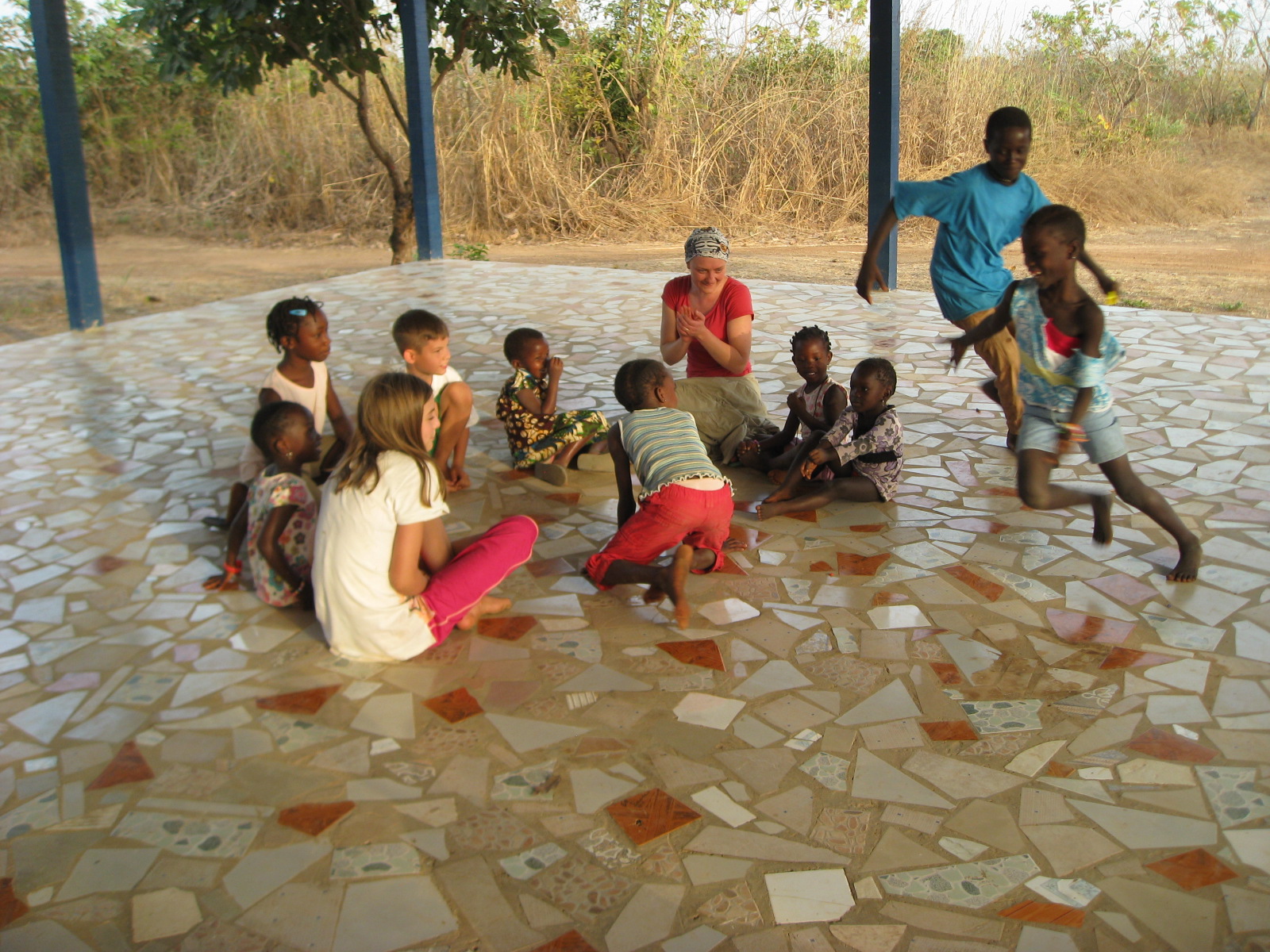
With so many children roaming the property that afternoon, their curiosity leading them to peek in the windows from time to time to catch a glimpse of the unusual activities going on inside that brightly decorated salon room, it was finally decided that Tonya was needed more outside than inside.  So Kate took her place on the floor to carry on with the scrubbing and rubbing of tired feet, and Heather took over the position of shoulder massager.  The squeals and laughter that were heard coming from the pavilion several hundred feet away attracted my attention until I could no longer resist taking a quick break from the facial station with camera in hand to capture the excitement that Tonya was generating among the children.  With the six visiting children together with seven of the eight that lived on the property, there was a sizeable group of sweaty little bodies sitting cross-legged in a circle on the floor of the shady pavilion.  Tonya had decided to teach them to play "duck duck goose".  Not knowing the Creole names of those particular fowl, however, she needed some suitable substitutes quickly.  Flapping her arms and pointing at the sky, someone finally interpreted her charade and provided her with the word calla, presumably meaning bird; and one of the American kids was able to teach her the word galinha.  And so it was that a group of African bush kids and American missionary kids had a blast playing "bird bird chicken." 


After the salon services were completed and the recipients were offering up hugs and expressions of gratitude with their orange, pink, green, and blue gift bags dangling from their grips, Kate decided to bless Iness and her children with a ride back to their village.  Iness and the youngest of her children piled into the backseat of the truck while the overflow climbed into the backend for the bumpy ride to her village.  Shortly after passing through the gate that marks the entrance to the center's property, we encountered a couple women heading home from the bulanga with the fruits of their day's labor on their heads.  Then a few little boys scooted quickly out of the road to let the truck pass, and a tired-looking older man appeared around the bend and motioned for the truck to stop.  Kate's local taxi service came to a halt while the man climbed over the side of the truck followed by the boys who saw an opportunity to catch a ride with the white lady.  When the truck reached the paved road the man smacked the side window loudly a few times, communicating to Kate that he was ready to disembark, and the hitchhikers all piled out shouting their "obrigados" as we waved and sent them on their way with cheerful "ciaos".  A short distance down the road, lined with people walking in both directions, we pulled off onto another dirt road for a short distance until it turned into a footpath and the grass roofs of Iness's village were just visible over the tops of the trees.  A crowd of about thirty young people was gathered at that intersection of road and path.  Was this the local hangout for older kids?  Or perhaps they were on their way home from school and just happened to be passing through that spot when we arrived.  Many of them rushed up to the truck to touch it, some reaching up for us to clasp hands and exchange greetings.  "Bo-tarde!  Bo-tarde!"  The shy ones hung back a little, but never took their eyes off us during the time it took for Iness and her children to disembark and for Kate to make a 12-point turn in that tiny space to head the truck back out the way we came in.   

Iness in her royal blue dress disappeared down the path into the elephant grass back to her difficult life.  But this time she returned home with more knowledge of Jesus and more to think about.  Hopefully one day she will place her trust in Him and find hope.